
Whitepaper · 2024
The Carve-Out: Innovation's Next Evolutionary Step
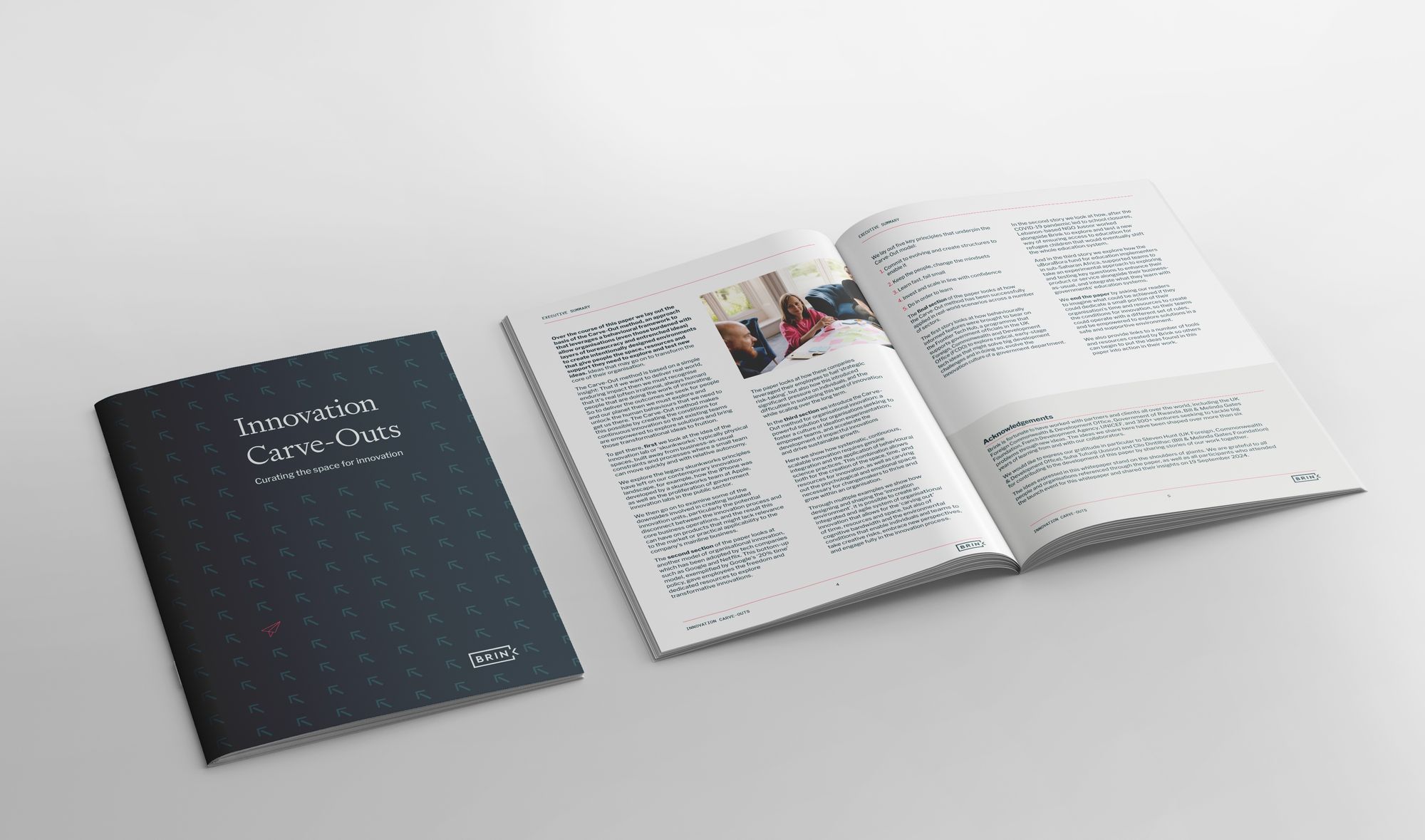
A whitepaper from Brink proposing the Carve-Out method, an approach that leverages a behavioural framework to simultaneously promote agility, foster a culture of ideation, and scale effectively without imposing unnecessary burdens on the core business.
If we want to deliver the outcomes we seek for people and the planet, then we must explore and unlock the human behaviours we need to get us there.
The golden ratio of innovation
In 2012, Bansi Nagji and Geoff Tuff published the Innovation Ambition Matrix, which included the “golden ratio” of resource allocation. Their research showed that firms which outperform their peers dedicate 70% of their resources to “safe bets” in their core, 20% to adjacent spaces, and 10% to transformational initiatives.
Today’s transformational initiatives are tomorrow’s core business. Neglecting the “10%” will, in the words of Nagji and Tuff, lead to a “steady decline in business and relevance to customers”.
Evolution isn’t only for the private sector
At Brink, we believe that this need for continuous evolution through transformational initiatives is as true for governments, philanthropists and donors as it is for the private sector.
We are in a time of multiple complex global challenges that will require a great deal of cooperation, creativity and innovation to solve. While there are many innovation techniques that look to understand these problems and to source ideas to solve them, too often they are not far-reaching enough to make a meaningful, lasting difference.
What’s required is a concerted effort to continuously evolve, to generate the necessary transformational breakthroughs, and to stay abreast of all that is coming next.
Innovation is a human process, not just a managerial one
The Carve-Out method acknowledges that innovation is not just a managerial process but a human one. It allows for the “carving out” of time, resources and space, but also of cognitive bandwidth and the environmental conditions that enable individuals and teams to take creative risks, embrace new perspectives, and engage fully in the innovation process.
In this way, the “Carve-Out” stands for both the organisational structures we create and the psychological environments we nurture, ensuring that people remain at the heart of innovation.
In this paper we
- Offer actionable steps and strategies for facilitating collaboration and creating the kind of culture that thrives on creativity, allowing for a dynamic and sustainable ecosystem for innovation.
- Present the Carve-Out as a practical framework for fostering a culture of innovation.
- Take a look at the limitations of existing innovation models and explore why traditional approaches often fall short, and even hinder the successful implementation of new ideas.
- Explore the foundations of the Carve-Out method, drawing on the behavioural sciences and organisational psychology and delving into the psychological factors that impede innovation.
Contributors
-
Clio Dintilhac
Senior Program Officer
Bill & Melinda Gates Foundation
-
Steven Hunt
Senior Energy Innovation Advisor
UK FCDO
-
Suha Tutunji
Head of Refugee Education
Jusoor